
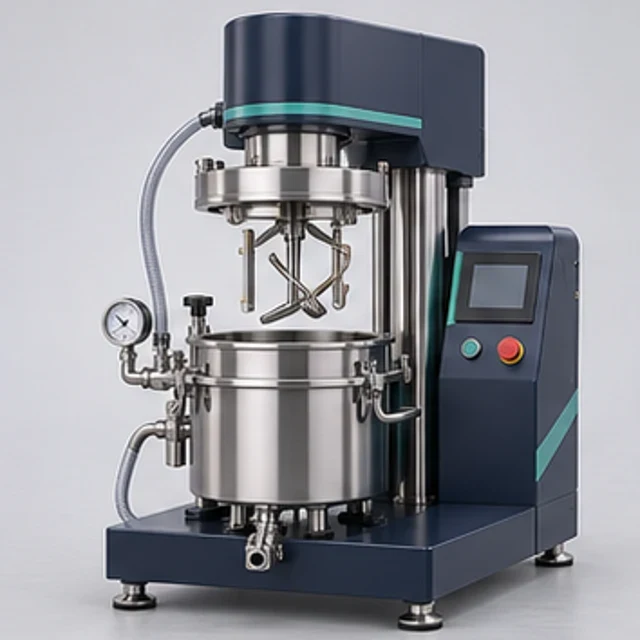
 REPRESENTATIVE CONCEPT
Under Development
Laboratory Vacuum Planetary Mixer
Li-ion Laboratory EquipmentLaboratory slurry mixing under controlled pressure.
AMB-LPM-05Explore equipment ↗
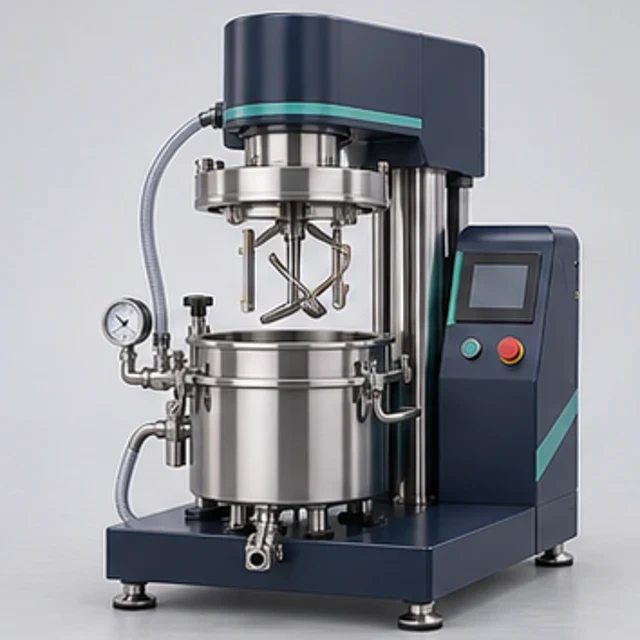
Intended for formulation trials that require local high-shear dispersion of powders or preparation of binder solutions before subsequent slurry processing.
| Parameter | Indicative Configuration |
|---|---|
| Machine type | Laboratory High-Shear Rotor-Stator Mixer |
| Batch capacity | 0.5–10 L, model-dependent |
| Available variants | 0.5 / 2 / 5 / 10 L |
| Mixing principle | High-speed rotor-stator |
| Rotor speed | Preliminary family target 1,000–12,000 RPM |
| Motor power | Preliminary model ratings 0.5–2.2 kW |
| Speed control | Variable-speed electronic control |
| Dispersing heads | Interchangeable rotor-stator heads |
| Rotor diameter | Approx. 20–70 mm, model-dependent |
| Wetted components | SS316L proposed |
| Mixing vessel | Removable stainless-steel vessel |
| Lift arrangement | Adjustable stand; powered lift optional |
| Timer | Programmable, target 0–999 min |
| Temperature monitoring | Digital temperature indication |
| Heating/cooling | Optional jacketed vessel |
| Control architecture | Digital controller; PLC/HMI optional |
| Electrical supply | 230 V / 415 V AC, model-dependent |
| Safety | Emergency stop, guarding, overload protection, applicable interlocks |
| Application | Battery material dispersion, powder wetting, slurry premixing and deagglomeration |
Specifications represent preliminary configurable design targets. Final parameters, material compatibility, performance and availability will be confirmed after application review and engineering validation.
Available speed depends on model, rotor/head, batch size and material. The family speed and motor ranges are not simultaneously attainable; the selected combination requires engineering verification.
A rotor-stator head creates a local velocity gradient as material passes through its working gap. Head geometry, circulation and residence time influence dispersion and heat generation; high shear is not suitable for every particle or binder system.
Binder-solution preparation, conductive-additive dispersion and screening of shear-sensitive slurry formulations. Confirm the intended process, materials and acceptance method during application review.
Mechanical interfaces, operating mode and control requirements are defined during engineering review. Available configuration choices depend on the agreed equipment scope.
Discuss manual or automated operation, local HMI, recipe control, PLC interfaces and process data requirements where appropriate. These options require scope confirmation.
Electrical supply, compressed air, cooling, exhaust, vacuum, floor loading and controlled-atmosphere requirements must be assessed against the selected configuration.
Heat generation and shear-sensitive binders require application-specific assessment. Rotor/head selection, motor loading, speed limits and the proposed safety protections require engineering verification. No explosion-proof or solvent-safe operation is established; solvent and hazardous-atmosphere use requires the appropriate process and electrical safety assessment.
A documented risk assessment, guarding review, material compatibility check and application-specific operating procedure are required before use. No CE, UL, IEC, hazardous-area approval or other certification is established by this listing. Conformity documentation depends on the agreed scope and destination requirements.
Read the Product Information Disclaimer
Request technical documentation and an application-specific configuration with your enquiry.
This listing represents an intended equipment or engineering offering. Feasibility, configuration and availability require confirmation. Please request the current engineering and supply status.
Share your materials, required capacity, process constraints and acceptance criteria. The team will review feasibility before confirming any custom scope.
REPRESENTATIVE CONCEPTLaboratory slurry mixing under controlled pressure.
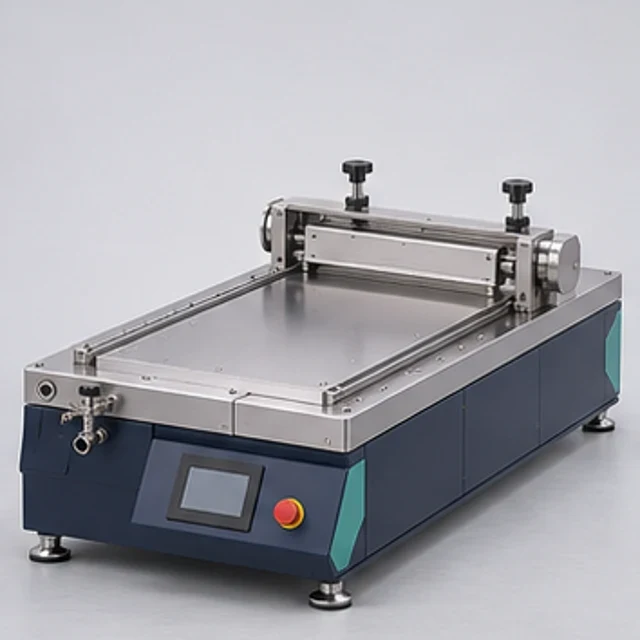 REPRESENTATIVE CONCEPT
Laboratory blade coating of electrode coupons.
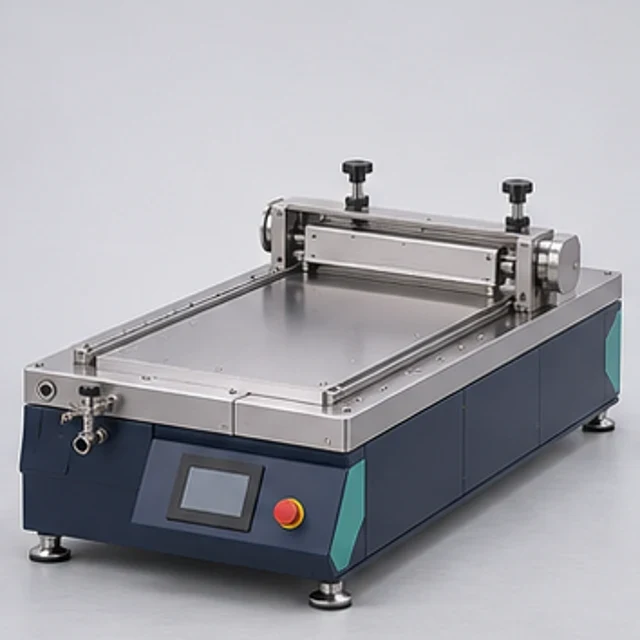 REPRESENTATIVE CONCEPT
Benchtop slot-die coating trials.